
Food & Fermentation · WHY BUY IT? MAKE IT!
Homemade Mason Jar Sauerkraut
Simple things you can make yourself.
- Difficulty
- Beginner
- Prep time
- Approximately 20–30 minutes
- Fermentation
- Usually 3–4 weeks at 70–75°F, although conditions can affect the time required.
- Yield
- Approximately 1 quart, depending on how tightly the cabbage packs.
Want to make this later? Bookmark this page so you can easily find the recipe when you're ready!
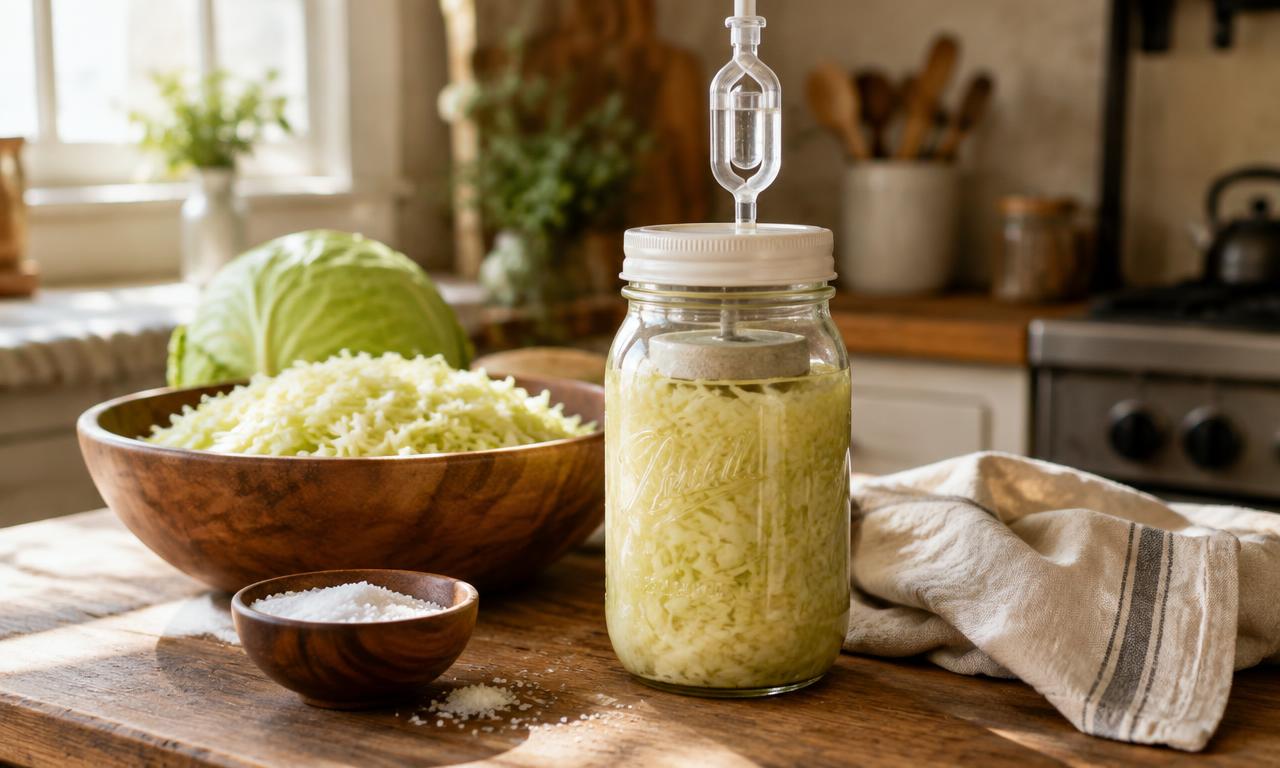
Why buy sauerkraut when you can make it yourself?
Welcome to WHY BUY IT? MAKE IT!, our weekly One More Farm series featuring practical recipes, homemade products, and old-fashioned skills that help you become more self-sufficient.
We're starting with homemade sauerkraut! You only need two ingredients: cabbage and salt. No vinegar is needed because this recipe uses natural fermentation.
With a Mason jar and a few basic supplies, you can turn fresh cabbage into tangy, homemade sauerkraut right in your own kitchen.
Let's make it!
Ingredients
- 2½ pounds fresh, firm cabbage, shredded
- 1¾ tablespoons canning or pickling salt
Important: Use the specified amount of salt. Do not reduce it. The cabbage-to-salt ratio is important for successful, safe fermentation.
Equipment Needed
- Kitchen scale
- Clean, sterilized quart Mason jar
- Large mixing bowl
- Knife or cabbage shredder
- Clean hands or a suitable utensil for massaging and packing the cabbage
- Glass fermentation weight or another suitable food-safe fermentation weight
- Fermentation lid with a one-way airlock or another appropriate arrangement that allows fermentation gases to escape
- Tray or shallow dish to catch overflow
A kitchen scale is important because the correct salt ratio depends on the weight of the cabbage.
Step-by-Step Instructions
Step 1: Prepare the cabbage
Remove the outer leaves of the cabbage. Rinse the cabbage under running water and drain it.
Cut the cabbage into quarters, remove the core, and shred it into thin strips.
Weigh out 2½ pounds of shredded cabbage.
Step 2: Prepare your Mason jar
Wash the jar and equipment thoroughly.
For this recipe, sterilize the glass jar by boiling it in water for 10 minutes, following established home-preservation guidance.
Allow the jar to cool before filling it. Handle hot glass carefully and avoid exposing it to sudden temperature changes.
Step 3: Add the salt
Place the shredded cabbage in a large, clean bowl.
Add 1¾ tablespoons of canning or pickling salt.
Mix thoroughly so the salt is evenly distributed throughout the cabbage.
Step 4: Let the cabbage release its juices
Allow the salted cabbage to sit for approximately 10 minutes.
Massage, squeeze, and mix the cabbage with clean hands until it softens and releases liquid.
The goal is to draw enough natural juice from the cabbage to cover it when packed into the jar.
Step 5: Pack the Mason jar
Pack the cabbage firmly into the prepared jar, pressing it down to remove air pockets.
Add all the juice remaining in the mixing bowl.
Leave approximately 2 inches of headspace above the cabbage to allow for expansion and bubbling during fermentation.
Step 6: Keep the cabbage submerged
Place a suitable fermentation weight over the cabbage. The cabbage must remain completely submerged beneath the brine throughout fermentation.
If the natural juices do not cover the cabbage, prepare additional brine using: 1 quart water and 1½ tablespoons canning or pickling salt.
Bring the water and salt to a boil, then allow the brine to cool completely before adding only enough to cover the cabbage.
Step 7: Cover the jar
Fit the jar with a fermentation lid that allows gases to escape, preferably a lid with a one-way airlock.
Follow the manufacturer's instructions for the fermentation equipment.
Place the jar on a tray to catch any liquid that bubbles out during fermentation.
Step 8: Ferment the sauerkraut
Keep the jar out of direct sunlight at approximately 70–75°F.
Check the jar regularly, two or three times each week. Make sure the cabbage remains submerged beneath the brine.
Fermentation produces gases, so the jar must have an appropriate way for them to escape.
At this temperature, fermentation commonly takes approximately 3–4 weeks, although the exact time varies.
Step 9: Check for doneness
After about three weeks, assess the sauerkraut for its characteristic tangy flavor and signs of completed fermentation.
Do not taste it if you observe mold, a slimy texture, or an unpleasant, rotten odor. Discard the entire batch if these signs occur.
When properly fermented, the sauerkraut should have its characteristic tanginess and firm texture.
Step 10: Refrigerate
Once fermentation is complete, keep the sauerkraut refrigerated in a clean, covered container.
Properly fermented sauerkraut can generally be refrigerated for several months.
Important: This recipe describes fermentation, not shelf-stable canning. Refrigerate the finished product unless you subsequently use an appropriate, tested canning process.
Important Tips for Success
- Weigh the cabbage instead of estimating its quantity.
- Measure the salt accurately.
- Use canning or pickling salt.
- Never reduce the specified salt ratio.
- Keep the cabbage submerged beneath the brine.
- Allow fermentation gases to escape.
- Check the jar regularly.
- Keep the fermentation temperature around 70–75°F.
- Refrigerate the finished sauerkraut.
Food Safety & Storage
- Fermentation requires appropriate salt concentrations, cleanliness, temperature management, and submersion beneath brine.
- If the sauerkraut develops mold, becomes slimy, or has a rotten odor, discard the entire batch without tasting it.
- This recipe is not a shelf-stable canning recipe.
Shop the Supplies I Use
Kitchen Scale
A kitchen scale helps you weigh your cabbage accurately so you can maintain the correct salt ratio.
Shop Kitchen ScalesComplete Fermentation Kit
Fermentation equipment helps keep your cabbage submerged and provides a suitable way for fermentation gases to escape.
Shop the Fermentation KitWide-Mouth Mason Jars
Wide-mouth Mason jars provide a convenient glass container for small-batch sauerkraut fermentation.
Shop Mason JarsCanning and Pickling Salt
Use the specified amount of canning or pickling salt for this recipe.
Shop Pickling SaltSome of the links on this page are affiliate links. If you purchase through one of these links, One More Farm may earn a small commission at no additional cost to you. Your support helps us continue sharing practical recipes, tutorials, and self-sufficiency resources. Thank you for supporting our small farm!